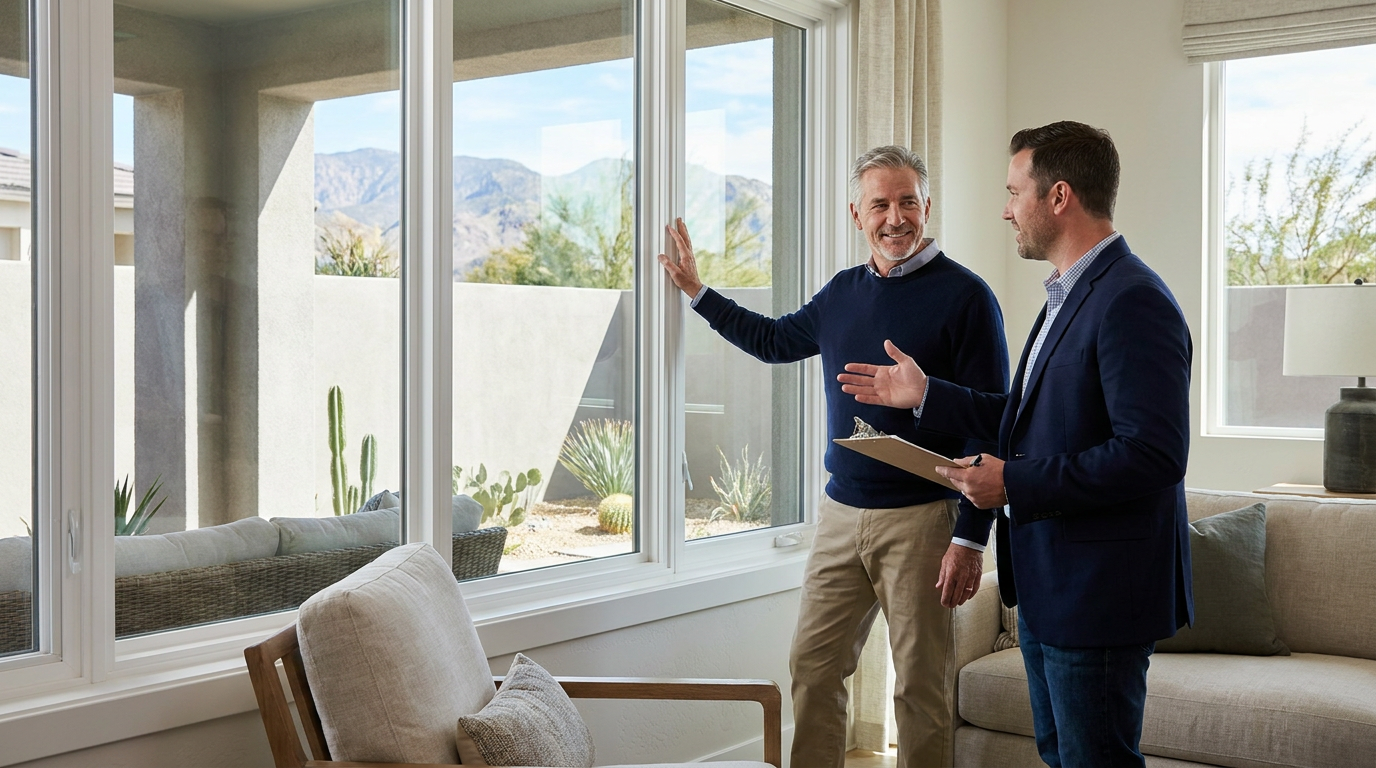
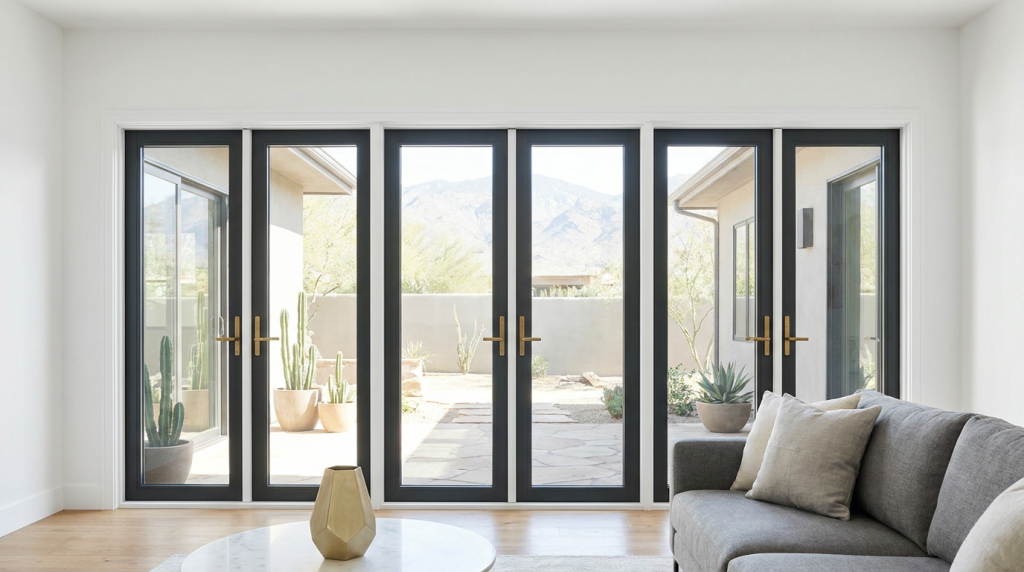
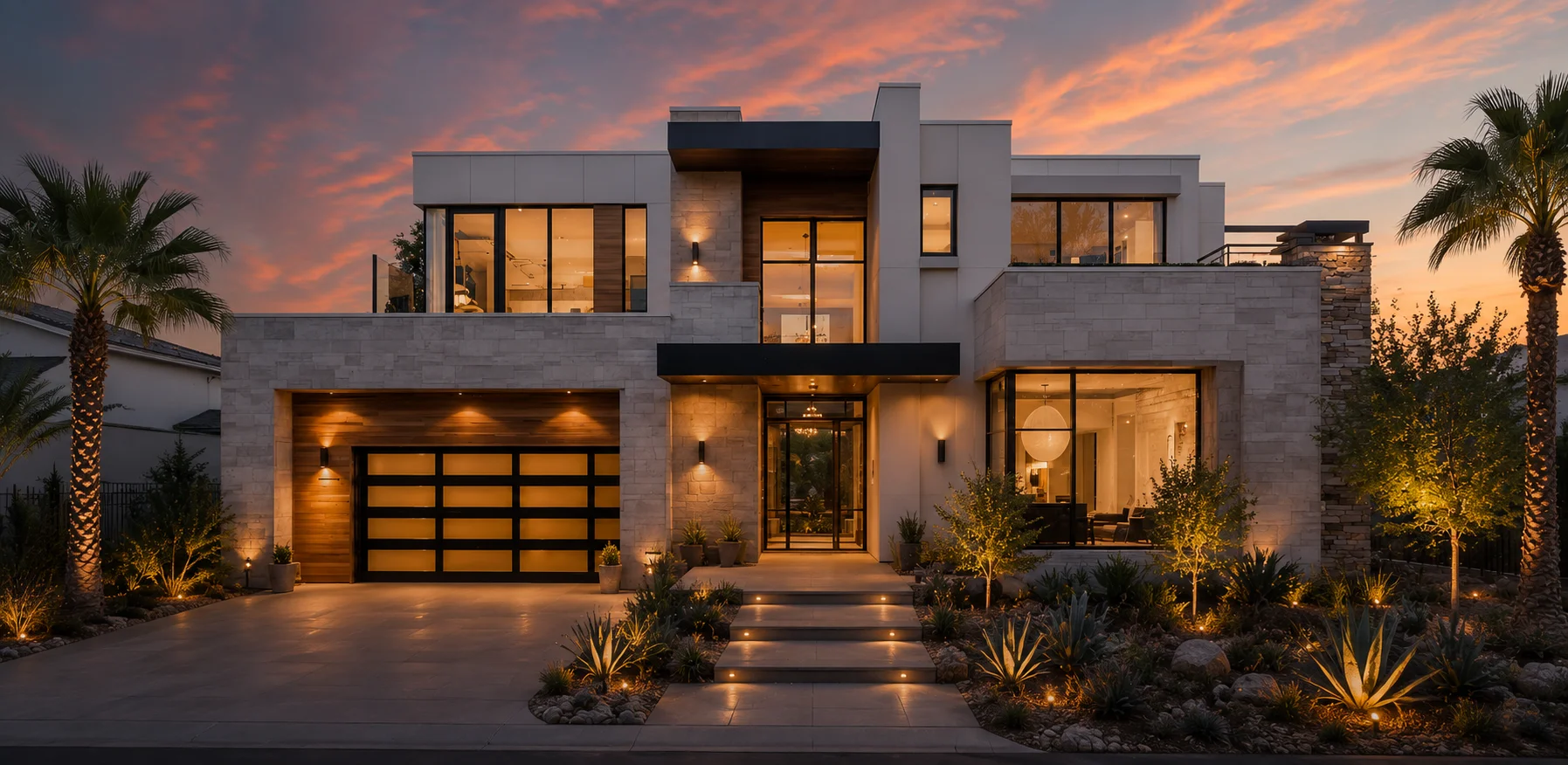
A useful consultation starts with a real in-home energy inspection that pinpoints which windows or doors are causing heat, drafts, or noise, so you can prioritize the right openings instead of replacing everything blindly.
In Las Vegas, the right recommendation should change by room, sun exposure, frame material, glass package, and frame condition, not come from a one-size-fits-all product pitch.
A consultation is only complete when you understand the installation method, the likely timeline and disruption, what the estimate includes, and what warranty and support look like after the job is done.
Most window and door companies show up with a measuring tape and a quote sheet. They walk the rooms, write the numbers, and leave you with a price. What they rarely do is explain why one bedroom runs ten degrees hotter than the rest of the house, or which openings are actually responsible for the drafts. A fast quote is not the same as a real diagnosis, and in a home built to production-housing standards under Las Vegas heat, that difference matters.
The questions you ask during a window or door consultation will tell you more about the company than any brochure will. A consultant worth trusting should inspect your home carefully, connect their recommendations to your specific comfort problems, and explain the options in plain English before any decision gets made. These seven questions help you judge whether that is what you are getting. The Window & Door Store offers a complimentary, no-obligation in-home consultation and energy inspection to walk you through exactly that process. Schedule your visit.
What a Good Consultation Should Cover
A good window consultation starts with your home’s actual problems, not a product catalog. Here’s what that should look like in practice:
Inspect existing openings for failed seals, frame condition, and sun exposure before recommending anything.
Ask which rooms run hottest or feel draftiest, then connect the findings to those specific areas.
Explain tradeoffs between materials, glass packages, and installation methods in plain language.
Cover project scope honestly, including what variables could affect cost or timing.
Leave you with clear next steps so you know exactly what gets replaced, how, and why.
ENERGY STAR recommends that window consultations account for your climate zone and specific performance targets, not just general upgrades. In Las Vegas, that means matching recommendations to real heat and sun exposure data, not a one-size pitch. The seven questions below give you a straightforward way to find out whether a consultation is doing that work.
Question 1: What Will You Inspect in My Home Before You Recommend Anything?
A good consultant should be checking the home before recommending a single product. That means walking the rooms that feel hottest, looking at which windows face west or south, and testing whether existing seals have failed. Orientation and solar exposure are real factors in how much heat enters through a window, and that air leakage at the frame is one of the most common performance problems in older homes. A thorough in-home energy inspection catches these issues before any replacement decision gets made.
That inspection also protects the homeowner from a blanket approach. Not every window in the house fails the same way. Some may have cracked seals causing fogging; others may have frames that have shifted and no longer fit the opening correctly. A targeted plan based on what the home actually needs, rather than a one-size quote for every opening, is what separates a genuine diagnosis from a fast estimate. The questions a consultant asks in those first 20 minutes tell you a lot about whether they are solving your comfort problem or simply closing a sale.
Question 2: How Do Las Vegas Conditions Change What You Recommend?
Las Vegas conditions change what a consultant should recommend in specific ways: your home’s orientation determines how much heat each facade absorbs, frame materials need to handle sustained extreme heat without degrading, and desert dust wears through seals faster than it does in most other climates. Southern Nevada summers push past 110 degrees, the sun hits some sides of a house harder than others, and dust works its way into frames and seals over time. A company that gives you the same product pitch it would give a homeowner in Seattle is not reading your home; it is reciting a script. The answer you want connects directly to your home’s orientation, the rooms that get the worst afternoon sun, and how well the current windows are actually holding up under those conditions.
Production homes built quickly across Henderson and Summerlin often came with the minimum window allowed at the time, which means thin glass, basic frames, and no real strategy for solar heat gain. A consultant who knows this market will check which exposures are taking the most heat and factor that into the scope. That local read changes the recommendation in practical ways: a west-facing bedroom in a tract home is a different project than a shaded north-facing living room three doors down, and a company that does not account for that will treat them the same. Replacement windows that hold up here are chosen for those specific conditions, not applied across the house from a standard pitch.
Question 3: Which Frame Material Makes the Most Sense for My Home?
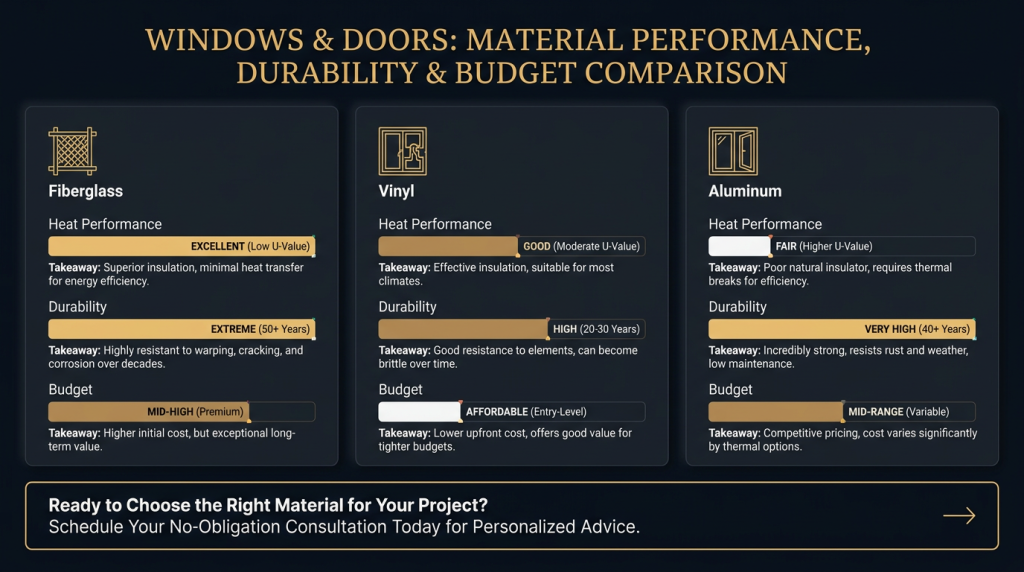
For most Las Vegas homes, fiberglass is the strongest frame choice: it handles sustained heat without warping and outperforms aluminum on thermal performance in a climate that stays extreme for months at a time. Frame material sits at the center of any window and door material options conversation for good reason: the wrong choice degrades visibly when temperatures push past 110 degrees, and no glass coating compensates for a frame that is actively conducting heat. A good consultant walks you through all three options, connects each one to how it holds up in Southern Nevada conditions, and tells you plainly which makes sense for your specific openings.
Here is how those materials compare at a practical level:
Fiberglass handles heat well, holds its shape over time, and does not expand and contract as dramatically as other materials when temperatures swing. Research from Lawrence Berkeley National Laboratory supports that low-conductivity frames like fiberglass deliver better baseline thermal performance, which matters in a climate where sun exposure is intense for most of the year.
Vinyl is the most common frame material in Las Vegas production homes and remains a solid, budget-friendly option. It insulates reasonably well and does not corrode, though quality varies and it can soften or warp in sustained extreme heat if the product grade is low.
Aluminum conducts heat readily, which means it can work against you when outside temperatures hit 110 degrees. ENERGY STAR guidance notes that metal frames require thermal breaks to perform in climates with significant heat loads. Without one, the frame itself becomes a path for heat to move into the home.
The conversation should connect material to the specific opening. A large west-facing window calls for a different answer than a shaded entry door, and a good consultant should make that distinction rather than recommending the same frame across every part of the home.
The Efficient Windows Collaborative points out that whole-window performance ratings account for frame material, not just glass, which means the frame choice affects how a window performs in real conditions, not just on paper.
If a consultant presents all three options the same way and lets price be the only deciding factor, that is worth noticing. In Las Vegas, frame material is a performance decision first.
Question 4: What Glass Package Will Cut Heat Without Darkening the House Too Much?
Frame material gets most of the attention, but the glass package is where a lot of the real heat-blocking work happens. Low-E glass uses a thin coating on the pane to reflect heat back before it enters the room, while still letting in usable daylight. A good consultant should be able to explain that in one sentence, not a technical lecture. If the answer sounds like a spec sheet, ask them to say it plainly.
The better question is not just which glass blocks heat, but which glass makes sense for each room. A west-facing bedroom that bakes from afternoon sun may need a different coating than a north-facing living room where natural light matters more. A room-by-room approach, like what gets reviewed during a complimentary in-home energy inspection, gives you a more accurate plan than applying the same glass package across the whole house and hoping for the best.
Question 5: Are You Recommending Insert Replacement or Full-Frame Replacement, and Why?
Insert replacement fits a new window unit into the existing frame, leaving the surrounding trim and structure in place. Full-frame replacement removes everything, frame included, so the opening can be inspected, resealed, and rebuilt from scratch. Both are legitimate approaches, but the right choice depends on what the existing frame actually looks like. As the Building America Solution Center notes, full-frame replacement gives installers access to the rough opening for proper air sealing and flashing, which directly affects long-term thermal performance.
A good consultant will inspect the frame condition before recommending anything. If the frame is solid, square, and free of damage, an insert can work well and cause less disruption to your walls and trim. If there is rot, warping, or a poor fit, full-frame is usually the better call, even if it costs more upfront. These are the kinds of replacement window installation questions worth pressing on, because the installation method affects how much glass area you get, how the finished opening looks, and how the window performs over time.
Question 6: What Will Installation Day Actually Look Like in My House?
This question catches a lot of homeowners off guard because they ask about the product but forget to ask about the day itself. That picture should be in front of you before you sign anything, not delivered on the morning of the job.
Here is what a straight answer should cover:
Who is on the job, start to finish. Ask whether one team handles measuring, installation, cleanup, and any construction work around the opening, or whether pieces of the project get handed off to subcontractors. One team with full responsibility means fewer surprises on the invoice and no one pointing fingers if something needs to be addressed.
How long the project will realistically take. Most window replacements can be completed in a single day, but the honest answer depends on the number of openings, the installation method, and whether any structural work is involved around a door or larger opening. A company that gives every job the same one-size timeline is not thinking about your home specifically.
Which rooms will be affected and when. For a family with kids and a daily routine, knowing which areas are out of commission and for how long matters. A good consultant walks through the sequence so you can plan around it, not scramble during it.
What cleanup looks like when the crew leaves. Dust, debris, and old frame material should not be your problem at the end of the day. Ask directly whether the team handles cleanup as part of the job.
What could push the schedule. Variables like frame condition, special-order sizing, or weather can extend a project. A company worth trusting names those possibilities upfront instead of letting them come as a surprise.
The product itself only delivers if the installation is done carefully and completely. A smooth day in your home is not a bonus feature; it is part of what you are paying for.
Question 7: What Is Included in the Price, and What Happens After Installation?
A good estimate should leave no room for guesswork. Before you sign anything, you want a clear picture of what upfront pricing and financing options look like, and an equally clear answer on what support looks like once the crew packs up and leaves.
Nevada’s Home Improvement Bill of Rights gives homeowners a useful baseline here: a contractor’s written estimate should spell out the full project price, the scope of work, payment schedule, and start and completion dates. If the estimate you receive is vague on any of those points, that is worth pressing on before you move forward.
Here is what a straight answer should cover:
Ask exactly what the estimate includes. Product, labor, permits, old window disposal, and any construction work tied to the opening should all be accounted for. At The Window & Door Store, one estimate covers the full scope of the project, so there are no line items that surface later.
Treat financing as a planning tool, not a sales tactic. A good consultant explains monthly payment options so you can weigh affordability against the comfort improvements you are actually after, without using financing to rush a decision. Flexible financing is available and worth asking about during the in-home consultation.
Get the warranty explained in plain language before you commit. The FTC’s guidance on warranty law notes that written warranty terms should be available before the sale is final. Ask whether the warranty covers the product, the installation, or both, and for how long.
Know who to call after the job is done. After-installation support should not be a mystery. The consultant should name a direct contact for any concerns that come up after the project is complete, so you are not left navigating a phone tree if something needs attention.
FAQ: Window and Door Consultation Questions Homeowners Ask Most
These are the questions that surface once a homeowner is actually weighing a decision: after the initial walk-through, when the estimate is in hand and the tradeoffs feel real. They deserve direct answers.
Do I need to replace every window at once, or can a consultation help me prioritize?
You do not have to replace everything at once. A thorough in-home energy inspection can identify which windows are driving the most heat gain or comfort problems in your home. That gives you a clear starting point, whether that is one room or the whole house.
Should I visit a showroom before the in-home consultation, or after?
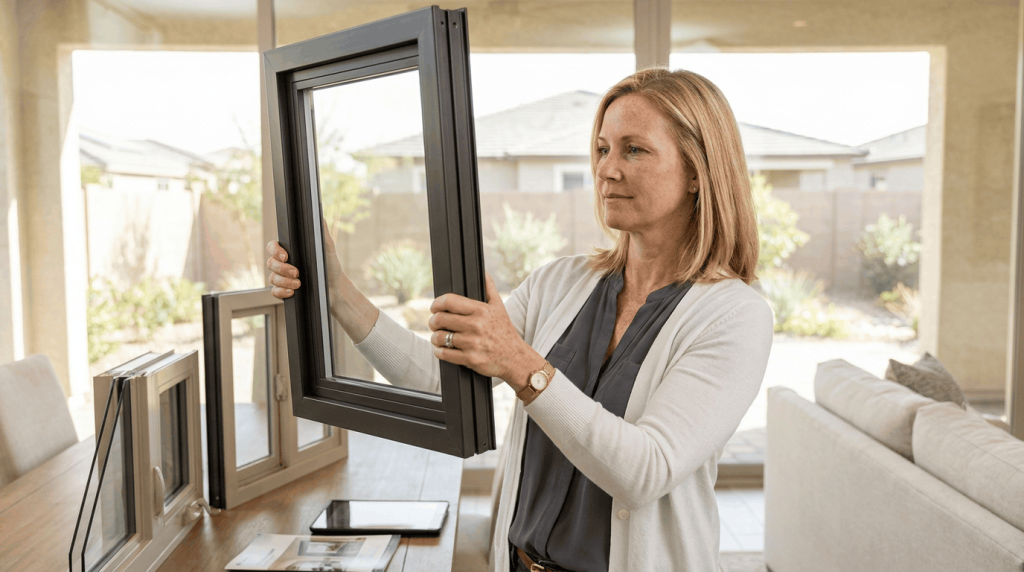
Either order works, but most homeowners find the showroom visit useful early on. Seeing and operating full-size windows and doors in person helps you understand your material and style preferences before a consultant starts narrowing options for your specific home.
How do I compare two estimates that recommend different materials or installation methods?
Ask each company to explain why they chose that material and that installation approach for your specific openings. If one recommends fiberglass and another recommends vinyl, the reasoning should be tied to your home, not just price. A vague answer is a sign the recommendation was not based on a real inspection.
Will replacement windows and doors actually reduce outside noise, or only in certain situations?
Better windows do help with noise, especially with thicker or laminated glass and tighter seals. The improvement is most noticeable in rooms facing a busy street or a neighbor’s yard. A consultant can point to which openings will give you the biggest difference based on where the noise enters your home. You can read more about how new windows affect everyday comfort if this is a priority for your household.
How much should a company explain during a consultation before I feel ready to move forward?
Enough that you understand what is being replaced, why, and what the installation will involve. A good consultant will walk through product options, explain the differences in plain language, and give you a clear scope before asking for any decision. If you leave with unanswered questions, the consultation is not finished. You can schedule a complimentary, no-obligation visit to see what that kind of conversation actually looks like.
Book the Consultation That Gives You Real Answers
What separates a useful consultation from a fast estimate is exactly what these questions test: whether the company knows your home before recommending anything. A real diagnosis names which openings are driving your comfort problems, which frame and glass choices hold up in Southern Nevada heat, and what the installation will involve before you spend a dollar. ENERGY STAR makes the same point: a proper in-home inspection helps homeowners prioritize the right projects, not just the most obvious ones. A number without that groundwork is a guess.
A fast quote without that groundwork is just a number. The Window & Door Store’s complimentary in-home consultation and energy inspection gives you a real look at what your home needs, explained in plain language, with no obligation to commit. Schedule your complimentary in-home consultation and walk away with a clear scope, honest recommendations, and the confidence to make the right call for your home.
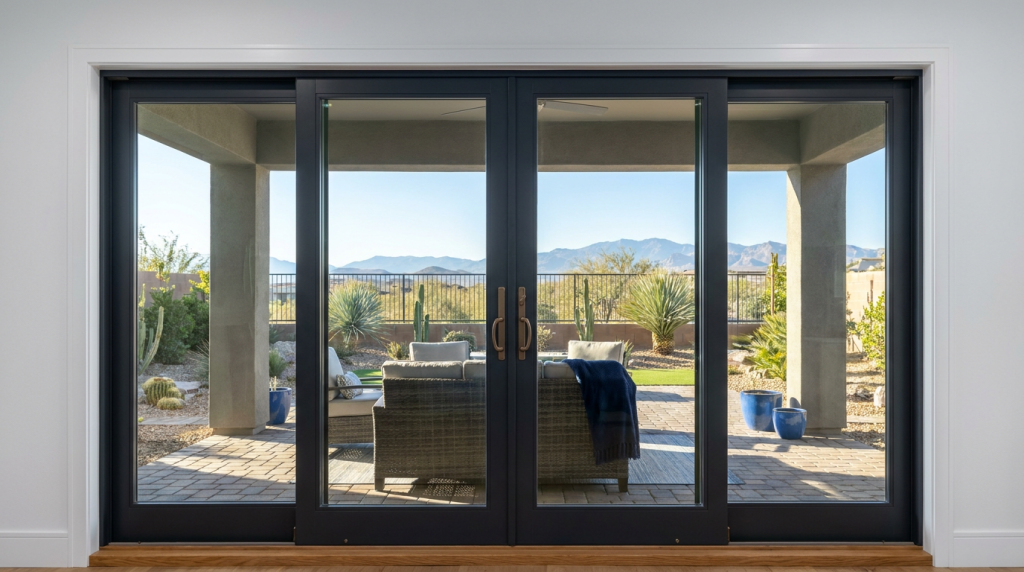
Key Takeaways: The best patio door for a Las Vegas home is the one that fits the opening, the backyard layout, and the heat, not the one that looks most dramatic in a photo. Sliding doors are usually the cleanest upgrade within an existing opening, while multi-slide doors are the stronger choice when the goal […]
A well-run window replacement project follows a clear sequence from in-home inspection to final walkthrough, with one quote and one team handling the job from start to finish.
What type of residential replacement project are you considering?
Number of Windows
Door TypeWhat type of doors are you looking to replace?
Your Address
Contact Details
Additional details
Add pictures to make your description more detailed.
I want to learn more about the Window and Door Store and schedule an in-home price quote. By submitting this form, which I agree is my signature, I consent to receive recurring informational and advertising calls, and emails from the Window and Door Store, including by automated technology or prerecorded voice. I understand consent is not required for purchase and that I can opt out at any time, I understand any Window and Door Store calls may be recorded. The Window and Door Store collects certain categories of personal information and uses this information in various ways, including order fulfillment and providing product information and services, as further described in our Privacy Policy. I have been provided The Window and Door Store’s Privacy Policy and agree to its Terms and Conditions. Message and data rates apply.